


A podcast about diabetes and genes
With Andrew Hattersley
and Maggie Shepherd
A podcast about diabetes and genes
With Andrew Hattersley
and Maggie Shepherd
Please note, this episode won’t show until the episode goes live at 9am on Boxing Day 2023.
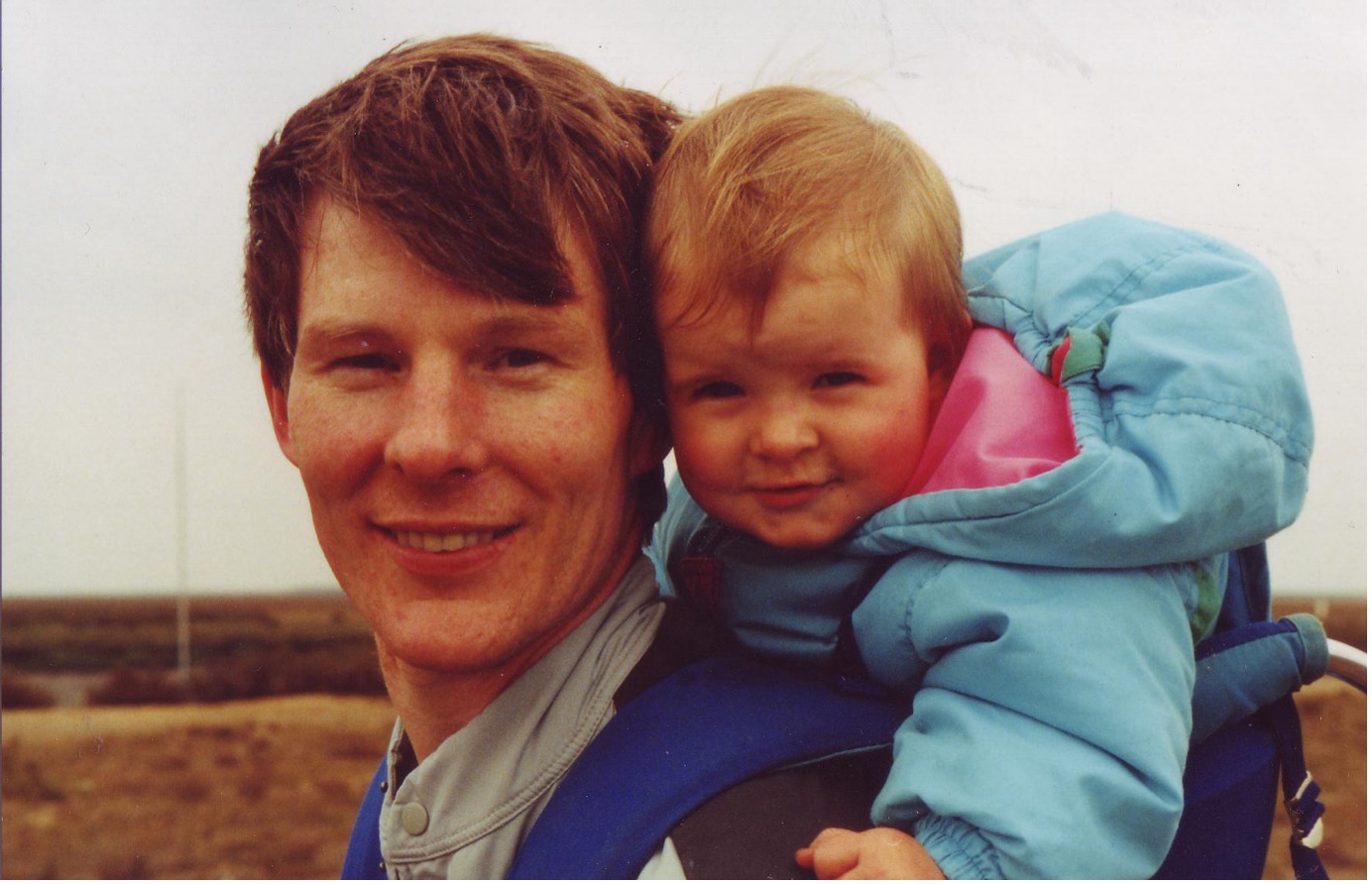
Andrew Hattersley in 1991 with his oldest daughter Ruth aged 7 months
Andrew Hattersley is now Professor of Molecular Medicine at the University of Exeter, and Honorary Consultant in Diabetes at the Royal Devon and Exeter Hospital in Exeter . Details about Andrew can be found here
https://medicine.exeter.ac.uk/people/profile/index.php?web_id=Andrew_Hattersley
or here
https://en.wikipedia.org/wiki/Andrew_Hattersley
This episode mentions his time as a medical student at Cambridge University and then Oxford University. It also discusses his early research in Oxford where he worked as a research student with Professor Robert Turner and Dr James Wainscoat between 1989 and 1992. In 1992 to 1994 he worked in Birmingham were he set up a research genetics laboratory.
His major research finding was that in a large family the diabetes was because of a genetic change in the glucokinase gene. This work is described in this paper i:
Linkage of type 2 diabetes to the glucokinase gene.
Hattersley AT, Turner RC, Permutt MA, Patel P, Tanizawa Y, Chiu KC, O’Rahilly S, Watkins PJ, Wainscoat JS.
Lancet. 1992 May 30;339(8805):1307-10. doi: 10.1016/0140-6736(92)91958-b.
PMID: 1349989
Other papers published form his research time in Oxford included these papers
1. Failure to detect cytomegalovirus DNA in pancreas in type 2 diabetes.
Hattersley AT, Lo YM, Read SJ, Eglin RP, Wainscoat JS, Clark A.
Lancet. 1992 Feb 22;339(8791):459-60. doi: 10.1016/0140-6736(92)91062-d.
PMID: 1371324
Stoffel M, Patel P, Lo YM, Hattersley AT, Lucassen AM, Page R, Bell JI, Bell GI, Turner RC, Wainscoat JS.
Nat Genet. 1992 Oct;2(2):153-6. doi: 10.1038/ng1092-153.
PMID: 1303265
3. Linkage analysis of glucokinase gene with NIDDM in Caucasian pedigrees.
Cook JT, Hattersley AT, Christopher P, Bown E, Barrow B, Patel P, Shaw JA, Cookson WO, Permutt MA, Turner RC.
Diabetes. 1992 Nov;41(11):1496-500. doi: 10.2337/diab.41.11.1496.
PMID: 1397724
4. Mutations of the glucokinase gene and type 2 diabetes.
Hattersley AT, Turner RC.
Q J Med. 1993 Apr;86(4):227-32.
PMID: 8327637 Review. No abstract available.
5. Clinical characteristics of subjects with a missense mutation in glucokinase.
Page RC, Hattersley AT, Levy JC, Barrow B, Patel P, Lo D, Wainscoat JS, Permutt MA, Bell GI, Turner RC.
Diabet Med. 1995 Mar;12(3):209-17. doi: 10.1111/j.1464-5491.1995.tb00460.x.
PMID: 7758256
McLellan JA, Barrow BA, Levy JC, Hammersley MS, Hattersley AT, Gillmer MD, Turner RC.
Diabetologia. 1995 Jun;38(6):693-8. doi: 10.1007/BF00401841.
PMID: 7672491
Saker PJ, Hattersley AT, Barrow B, Hammersley MS, McLellan JA, Lo YM, Olds RJ, Gillmer MD, Holman RR, Turner RC.
Diabetologia. 1996 Nov;39(11):1325-8. doi: 10.1007/s001250050577.
PMID: 8932999